Why an unexpected outcome doesn't necessarily mean you made the wrong decision
Have you ever looked back at a decision that didn't turn out as you expected and thought, I should have known better?
Perhaps you took a job that seemed right at the time, but it turned out to be very different from what you expected. Perhaps you decided to stay in a relationship, or leave one, believing you were making the best choice available to you. Perhaps you said yes to something, turned something down, moved somewhere or made a decision about your family that seemed perfectly reasonable at the time.
And then something happened that you hadn't anticipated.

Suddenly, the decision itself can become the problem. You start wondering whether you should have known, whether you missed something obvious, or whether you were simply not very good at making decisions.
20-20 hindsight is a wonderful thing, however it can be rather unkind.
We make decisions with the information available to us at the time. Afterwards, we have more information. We know what happened, what other people did, what changed and what we perhaps hadn't considered. It can then feel as though the outcome was obvious all along.
It wasn't.
The person making the decision didn't have the benefit of hindsight. She had the information she had, the circumstances she was in and whatever experience she had at that point in her life.
That doesn't mean every decision we make is necessarily a good one. Sometimes we ignore information that was available to us. Sometimes we make choices for reasons we later realise weren't particularly helpful. Sometimes we simply get things wrong.
Being able to recognise that is part of being able to make sensible decisions.
But there is a difference between recognising that a decision didn't work and turning the outcome into a judgement about yourself.
When a decision becomes evidence against you
There is a big difference between saying:
I made a decision that didn't work out as I expected.
and:
I was wrong to trust myself.
The first is an observation about what happened. The second is a judgement about your ability to make decisions in the future.
Once we start making that leap, it can become very difficult to trust ourselves again.
You might begin to look outside yourself for reassurance. What does everyone else think? What would they do? Does this sound right? Would you make the same choice?
There is nothing wrong with asking another person for their perspective. In fact, there are times when it is exactly what we need. Somebody else may notice something we have missed, have experience that we don't have, or ask a question that helps us see a situation differently.
The difficulty comes when seeking perspective quietly becomes seeking permission.
Instead of listening to another person's opinion and then making our own decision, we start looking for somebody who can make us certain that we are making the right one.
But certainty is an impossible standard.
You cannot make decisions with information you don't have
There are very few decisions in life where we can know exactly how things will turn out.
We can gather information. We can think carefully. We can ask questions, consider other people's views and take our time. We can try to anticipate what might happen.
Eventually, though, we still have to decide.
And sometimes things work out as we hoped. Sometimes they don't. Sometimes something happens that we simply could not have anticipated.
That is one of the uncomfortable realities of making decisions: you cannot make a decision with information you don't have.
Yet when something goes wrong, we can find ourselves judging our past selves as though we should have known.
I should have realised.
I should have seen it coming.
I should have known better.
But could you genuinely have known?
That's a much more useful question.
If the answer is no, then perhaps the decision deserves a little more fairness than you have been giving it.
Self-trust doesn't mean always being right
Perhaps one reason we struggle with self-trust is that we have quietly defined it as being right.
If I trust myself, I should make good decisions.
If I make a good decision, it should work out.
If it doesn't work out, then I must have been wrong to trust myself.
That creates a rather impossible standard.
Self-trust doesn't mean believing that you will always get things right. It means being able to listen to your own judgement, consider other people's perspectives without automatically handing the decision over to them, and make the best decision you can with the information available to you.
It also means being able to live with the fact that you don't know everything.
You can make a thoughtful decision and still be uncertain. You can listen to somebody else's opinion and change your mind. You can discover that something isn't right for you after all and make a different choice.
None of those things mean you have failed to trust yourself.
In fact, being able to change your mind may be one of the signs that you are listening to yourself rather than desperately trying to prove that your original decision was right.
When you are very good at understanding everyone else
There is another aspect of this that I think is worth noticing.
Some people become extremely good at understanding other people's perspectives. They can see why someone is upset, understand why one person reacted the way they did and why somebody else reacted completely differently. They can explain one person's position to another and see both sides of an argument.
Those can be wonderful qualities.
But if you are constantly considering everybody else's perspective, your own can become surprisingly difficult to hear.
You know why they think what they think. You understand why they feel what they feel. You can see the reasons behind their behaviour.
And somewhere in the middle of all that understanding, you may lose sight of a much simpler question:
What do I think?
Not what does everyone else think. Not which answer will cause the least difficulty. Not which position can I understand most easily.
What do I actually think?
That question doesn't mean ignoring everybody else. It means remembering that their perspective is information for you to consider, not necessarily an instruction you have to follow.
What if the decision wasn't the problem?
Sometimes, of course, the decision really was a mistake.
Perhaps there was information you overlooked. Perhaps you made a choice based on fear, pressure or wishful thinking. Perhaps you would make a completely different decision now.
That doesn't mean you have to condemn the person who made the original choice.
You can acknowledge that you would do things differently now and still have compassion for the person you were then. You can learn something without turning the lesson into a verdict.
There is an important difference between:
I wouldn't make that decision now.
and:
I should never have trusted myself to make that decision.
The first allows you to grow. The second teaches you to distrust yourself.
And if every mistake becomes evidence that you cannot trust your own judgement, you are likely to become increasingly dependent on other people's opinions.
A different question to ask yourself
Perhaps instead of asking:
Was that the right decision?
we could ask:
What did I know at the time?
What did I reasonably expect?
What could I not have known?
What have I learned since then?
Those questions don't remove responsibility. They simply put the decision back into the circumstances in which it was actually made.
You may still decide that you would choose differently now. You may even wish you had made a different decision then.
But you can recognise that without using hindsight as evidence against yourself.
There is something quite freeing about being able to say:
I made the best decision I could with what I knew then, and it didn't work out as I expected.
That sentence doesn't say that everything you do is right. It doesn't say that you shouldn't learn from your mistakes or listen to other people.
It simply recognises that you made the decision from where you stood at the time.
If you are still going over a decision
If there is a decision you are still thinking about, try separating what you know now from what you knew then.
What information did you actually have when you made the decision? What were you hoping for? What were you concerned about? Whose opinions were influencing you? Were you asking for perspective, or were you looking for someone else to tell you what to do?
Then look at what happened afterwards. What surprised you? What could you not reasonably have known? What do you understand now that you couldn't have understood then?
Finally, ask yourself what you have learned without turning the experience into a judgement about yourself.
Would you make the same decision now? Perhaps not.
But that isn't necessarily the most important question.
A more useful question might be whether you can trust yourself to make the best decision you can with the information you have, knowing that you cannot control the outcome.
A different way to look at your decisions
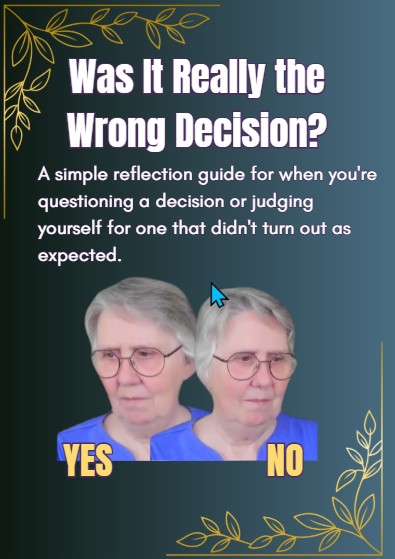
I've created a short reflection guide called Was It Really the Wrong Decision? for anyone who has a decision they are still questioning, or who finds themselves judging a past decision because things didn't turn out as expected.
It takes you through what you knew at the time, what happened afterwards and what you can learn without turning the experience into evidence that you cannot trust yourself.
You don't have to become someone who is certain about every decision.
You don't have to stop listening to other people.
And you don't have to convince yourself that every decision you've ever made was the right one.
Perhaps self-trust is something quieter than that.
Perhaps it is knowing that you can listen to your own judgement, consider other people's perspectives, make the best decision you can with what you know, and if things don't turn out as expected, deal with what happens next.
And perhaps that is a much kinder and much more realistic way of thinking about yourself.


